
A startup ecosystem is not simply a collection of space, policies, or individual events. It grows when founders meet investors, when international students begin to see themselves as future entrepreneurs, and when experts, companies, institutions, and policymakers gather around real opportunities for cooperation.
Throughout 2026, Startup Alliance has brought together founders, researchers, students, companies, institutions, and international delegations through international dialogues, pitch nights, expert visits, founder gatherings, healthcare salons, student exchanges, and global startup programmes.
Each activity takes a different form, but all serve the same purpose: helping international talent understand Beijing, enter its market, and participate meaningfully in its innovation ecosystem.
January | China × Brazil Innovation Dialogue
Startup Alliance hosted the China × Brazil Innovation Dialogue at the LINGSYNC International Digital Co-Creation Center in Beijing, joined by its partner FCGI and a delegation of young Brazilian innovators and technology professionals organised by Na Prática, a leading high-potential talent platform in Brazil.
The dialogue focused on connecting the innovation ecosystems of China and Brazil, supporting international young talent in China, and creating new opportunities for cross-border entrepreneurship and technology cooperation. Participants exchanged perspectives on talent development, innovation-resource collaboration, and links between international markets.
The event gave the Brazilian delegation a closer view of Beijing's entrepreneurial environment while creating a foundation for longer-term cooperation between Startup Alliance and Brazil's innovation community.
Through talent exchange, ecosystem collaboration, and global connections, the dialogue reflected Startup Alliance's wider goal: helping outstanding international talent not only come to China, but find the resources, partners, and pathways needed to grow here.
April | A New Home for International Entrepreneurship
The Chaoyang International Talent Entrepreneurship Park officially opened its doors in Beijing.
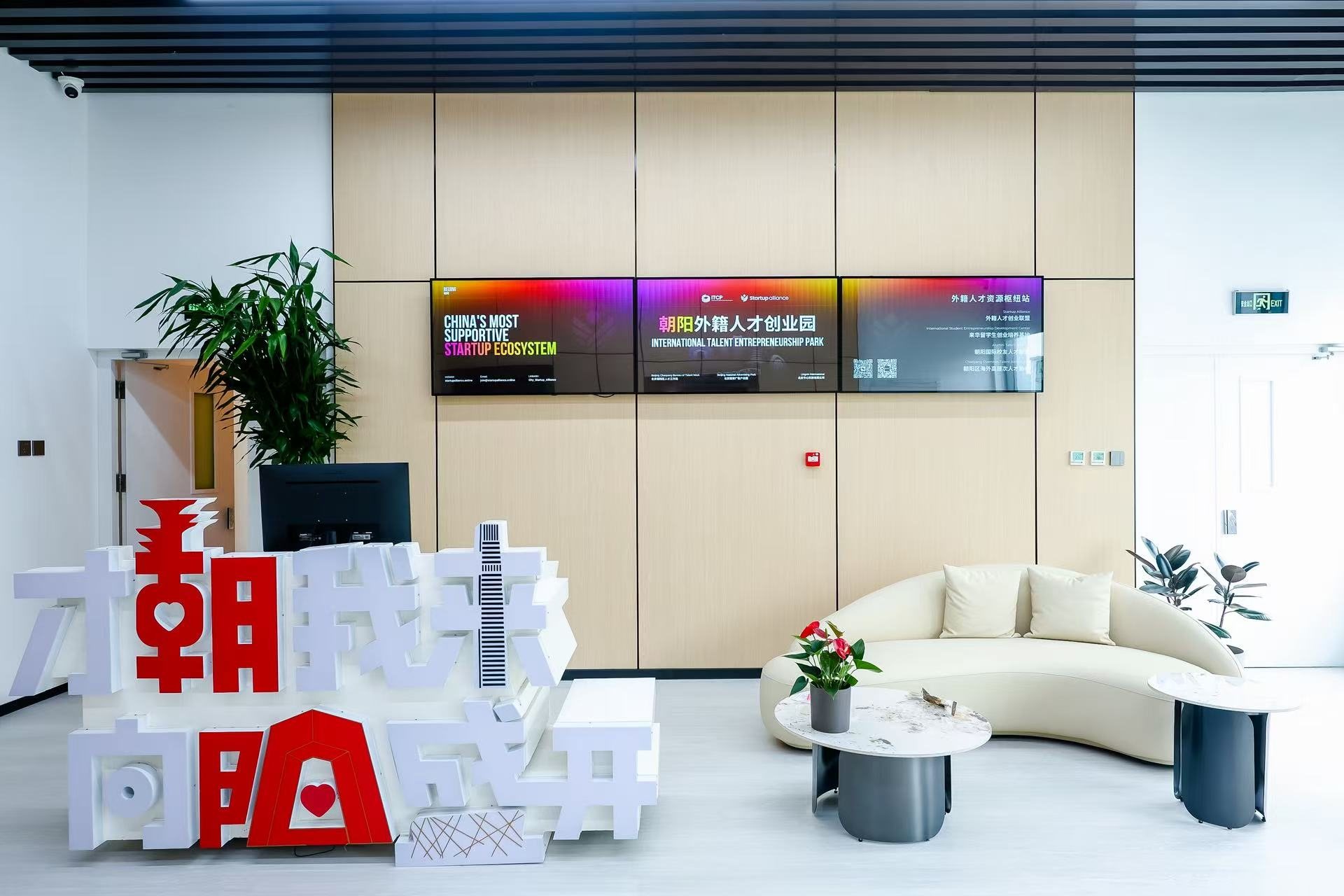
Operated by Startup Alliance, the park was established as a dedicated entry point for international founders seeking to establish and grow their businesses in China. It brings together policy guidance, workspace, company registration support, professional services, investor connections, industry resources, and an international founder community within one coordinated platform.
The launch represented more than the opening of a new workspace. It marked the beginning of a practical support system built around the real questions international entrepreneurs face when entering China: where to begin, which policies apply to them, who to connect with, and how to find partners, customers, investors, and local support.
Startup Alliance was created to make that process easier — and to ensure that international founders do not have to navigate China's startup ecosystem alone.
April | German Accelerator Pitch Night
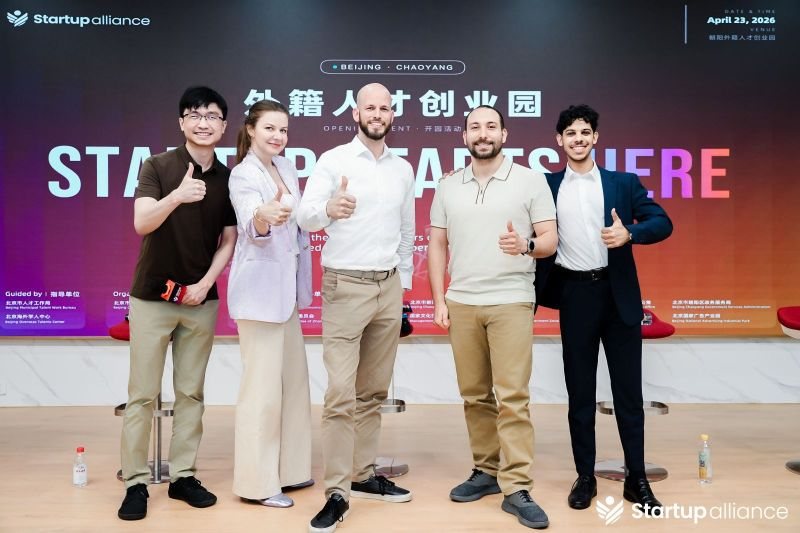
Only hours after the park officially opened, its event space was already being used for exactly what it was created to support.
Startup Alliance hosted the German Accelerator Pitch Night, organised by Start2 Group and Founders Lair as part of the German Accelerator China Market Discovery Programme.
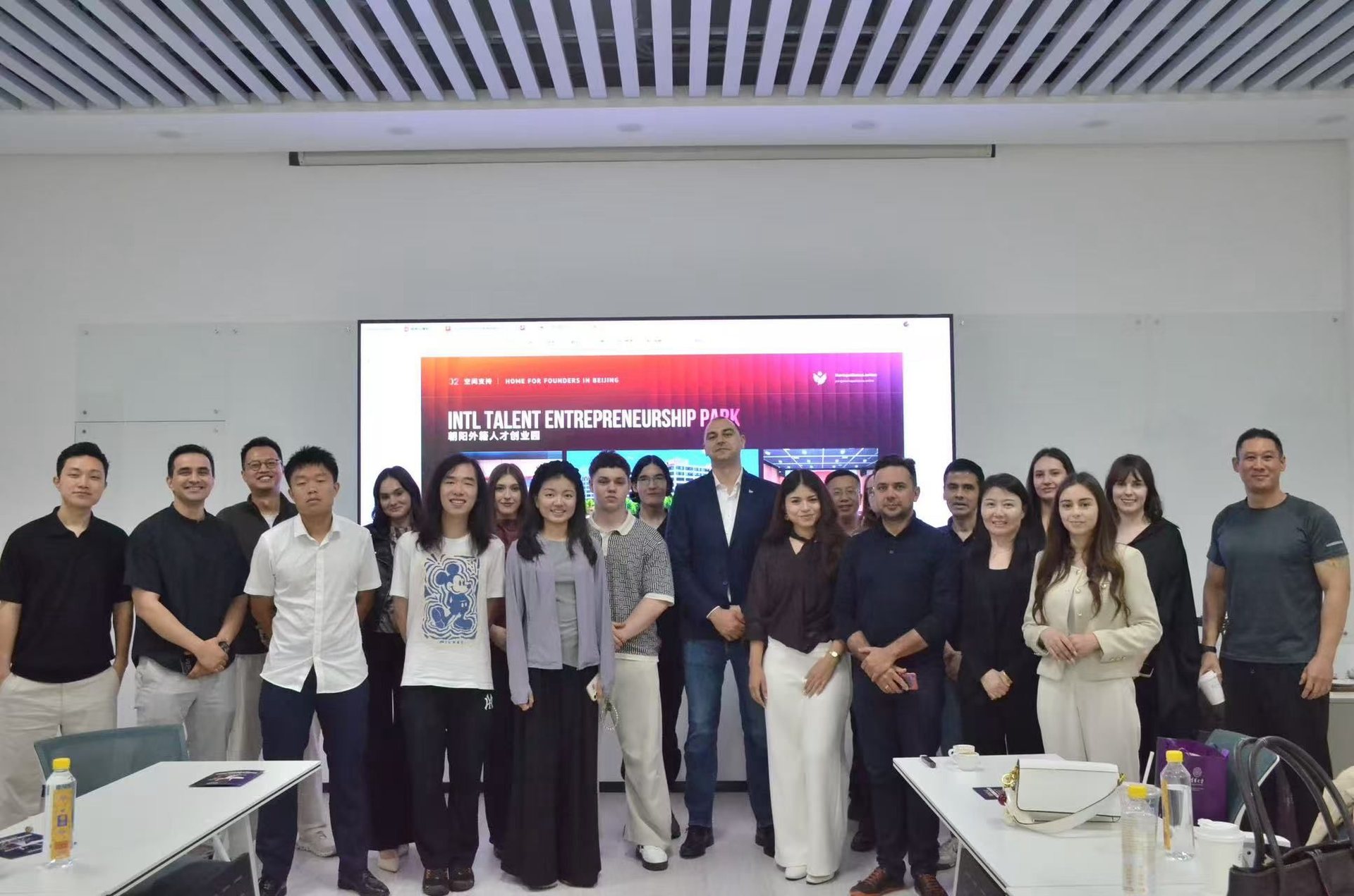
German startups presented their technologies and plans for the Chinese market to an audience of investors, founders, industry specialists, and ecosystem partners. Following the pitches, participants discussed localisation, potential customers, market entry, and opportunities for industrial cooperation.
For the participating founders, the evening offered more than a stage. It created an opportunity to test assumptions, receive local perspectives, and begin building relationships that could support their next steps in China.
From its first evening, the park was already becoming a place where global ideas could meet local knowledge — and where conversations could begin turning into action.
May | GNIS Overseas Experts Beijing Tour
The Chaoyang International Talent Entrepreneurship Park welcomed the GNIS Overseas Experts Beijing Tour, bringing international expertise into direct conversation with Beijing's technology and entrepreneurship ecosystem.
The delegation included 15 artificial intelligence experts and scholars from 11 countries, representing institutions and companies including Intel, IBM, the University of Oxford, and the Technology Innovation Institute in Abu Dhabi.
During the visit, the experts learned about Chaoyang's international innovation environment and connected with local technology companies to explore potential areas of cooperation.
Startup Alliance Secretary-General Wahed Ahmadzai introduced the support available to international founders and researchers interested in developing projects in Beijing. Representatives from organisations including Thales Group, PepsiCo, and Ghent University also shared perspectives on innovation, international collaboration, and opportunities within China's technology ecosystem.
The visit connected global expertise with local companies, institutions, and resources, creating opportunities for future scientific, technological, and commercial cooperation.
ITEC x Startup Alliance
Startup Alliance is working closely with ITEC 2026 — the 14th Chaoyang International Talent Entrepreneurship Conference — to connect promising international projects with the practical resources needed to build and expand in Beijing.
ITEC identifies founders, researchers, university spin-offs, and emerging-technology teams with strong innovation potential. Startup Alliance supports these teams with policy guidance, workspace, company registration, investor connections, industry resources, market-entry support, and access to Beijing's wider entrepreneurship ecosystem.
Together, ITEC and Startup Alliance create a more complete pathway for international founders. Teams are not only given a platform to present their ideas through ITEC. They can also access the support needed to transform those ideas into registered companies, pilot projects, industry partnerships, fundraising opportunities, and long-term operations in China.
The first ITEC 2026 Online Roadshow will take place on July 28. Selected founders will pitch their projects online, connect with relevant ecosystem partners, and compete for the opportunity to be fast-tracked to the ITEC Global Finals in Beijing.
By combining ITEC's international talent pipeline with Startup Alliance's founder resources and local ecosystem connections, the collaboration can create value beyond the competition itself. It can help global projects enter the Chinese market more effectively, connect international innovation with local industries, attract new entrepreneurial talent to Chaoyang, and strengthen Beijing's links with startup communities around the world.
For participating founders, ITEC is therefore more than a competition. It is an entry point into Beijing — and the beginning of a longer journey supported by an ecosystem ready to help them grow.
June | Singapore China Association Youth Chapter Visit
The Chaoyang International Talent Entrepreneurship Park welcomed members of the Singapore China Association Youth Chapter during their Beijing–Tianjin business study programme.
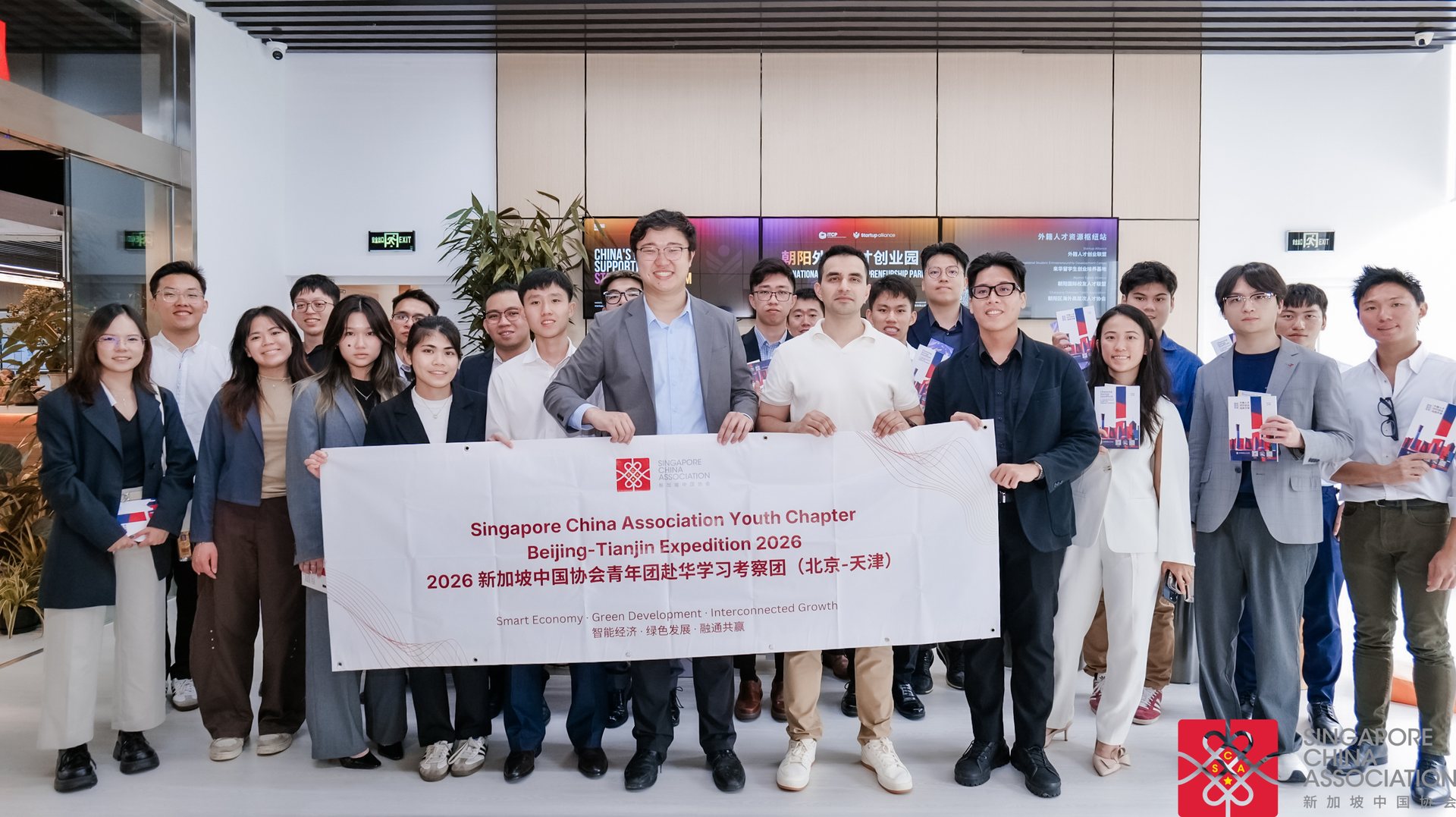
The delegation brought together young professionals, students, and emerging entrepreneurs interested in learning more about China's business and innovation environment.
During the visit, participants explored opportunities for international talent and entrepreneurs in Chaoyang and exchanged perspectives on entrepreneurship, cross-border business, and cooperation between China, Singapore, and the wider ASEAN region.
The visit gave the delegation an opportunity to engage directly with Beijing's international startup community and gain a closer understanding of how young people can participate in cross-border innovation.
International cooperation often begins before a company enters a new market — when young people encounter new ideas, build cross-cultural relationships, and gain first-hand exposure to another country's business and innovation environment.
By creating space for these exchanges, Startup Alliance hopes to support a new generation of globally minded entrepreneurs and connectors capable of building lasting links between markets.
June | Startup Alliance × Tsinghua University Student Exchange Association: Connecting E-Commerce Expertise with Global Market Opportunities
In collaboration with the Tsinghua University Student Exchange Association, Startup Alliance hosted a cross-border e-commerce session featuring a Bulgarian industry expert, international students, and representatives of Chinese companies.
The presentation compared the e-commerce landscapes of China and Southeastern Europe, examining differences in consumer behaviour, digital platforms, and business models. It also explored the opportunities available to Chinese brands and businesses seeking to enter and grow within European markets.
The conversation continued well beyond the presentation, with participants raising detailed questions about market entry, consumer behaviour, digital commerce, logistics, and cross-border growth.
The event demonstrated the value of collaboration between Startup Alliance and the Tsinghua University Student Exchange Association: connecting international industry experience with university talent and Chinese companies, and turning cross-cultural exchange into practical market knowledge and new opportunities for cooperation.
June | China–Russia Forum on Innovation, Market Access, and Business Cooperation
Startup Alliance welcomed a delegation of working MBA participants from the Russian Presidential Academy of National Economy and Public Administration, representing leading companies across a range of industries in Russia.
The visit began with a tour of the Chaoyang International Talent Entrepreneurship Park led by Startup Alliance Secretary-General Wahed Ahmadzai, followed by the 2026 China–Russia Forum on New Quality Productive Forces and Business Innovation. The forum was jointly organised by the park and RANEPA, with support from Miles & Minds and Inno Bridge.
The programme brought together representatives from government, academia, business, and the innovation community to discuss practical opportunities for deeper China–Russia cooperation. Opening remarks were delivered by Guan Changhai from the Beijing Overseas Talents Center, Alexander Druzhinin from the Russian Embassy in China, and Professor Alexey Kuznetsov, Director of the EMBA Programme and International Cooperation Department at RANEPA's International Business School.
During the thematic sessions, Wahed introduced Beijing's innovation and entrepreneurship ecosystem and the support available to international founders through the park. Evgeny Kosolapov, Chief Representative of the Skolkovo Innovation Center in China, discussed Russia's innovation ecosystem, technology transfer, and international scientific cooperation. Dr. Tang Linyao from the Chinese Academy of Social Sciences addressed AI governance, digital economy regulation, data compliance, and international market access.
RANEPA MBA representative Svetlana Solovyova also shared perspectives informed by her experience in cross-border tax consulting. The programme continued with a roundtable on the development of Chinese and Russian companies in Beijing, focusing on business-model innovation, market access, and international talent cooperation.
The forum concluded with open networking, one-to-one project discussions, and business matchmaking between the Russian delegation and participating companies.
Startup Saturdays
Startup Saturdays are informal weekly coffee chats for founders, aspiring entrepreneurs, mentors, and members of Beijing's international startup community.
Every Saturday, participants meet at the park to exchange ideas, discuss what they are building, share challenges, explore opportunities, and connect with others working across different industries and markets.
There is no formal pitching structure. The focus is simply on open conversation, useful connections, and creating a consistent space where founders can meet and learn from one another.
June | Johns Hopkins "Big Health" Salon: How AI Is Reshaping Healthcare
The Chaoyang International Talent Entrepreneurship Park welcomed the seventh edition of the "Big Health" salon series, hosted by the Johns Hopkins University Beijing Alumni Association.
Under the theme "AI Healing the World: Reshaping Health," the salon brought together professionals from healthcare, technology, academia, investment, and industry to discuss how artificial intelligence is transforming health services and responding to the challenges of an ageing society.
The keynote session was delivered by Professor Sheng Ying, Distinguished Professor at Shanghai University's School of Medicine and Executive Dean of the Institute for Integrated Development of Geriatric Health. Drawing on her experience across healthcare investment, academic research, digital health, and philanthropic practice, Professor Sheng explored how AI can support elderly care, chronic disease management, primary care, and more inclusive public health systems.
The discussion examined the transition from reactive treatment towards proactive health management, with AI extending healthcare beyond hospitals and into people's homes and daily lives. Participants also discussed how wearable devices, continuous health data, and intelligent systems can support more informed and human-centred clinical decisions.
The salon was moderated by Wu You, Managing Director of Futeng Capital and a Johns Hopkins University Doctor of Public Health graduate. The roundtable brought together Dr. Yang Yanyan, Deputy Director of the Department of Rehabilitation Medicine at Peking University Third Hospital; Zhao Xueda, founder of the uAitaRing smart ring; and Qiao Dan, Head of Brand and Marketing at AI wearable company Looki.
Their perspectives connected clinical rehabilitation, smart-hardware development, healthcare investment, and the commercialisation of AI-powered health solutions. The speakers also considered how healthcare may evolve by 2035 or 2040 as continuous data collection, intelligent decision-making, and human–machine collaboration become increasingly integrated into health management.
Through the keynote presentation, roundtable discussion, audience Q&A, and networking session, the event created a valuable platform for healthcare entrepreneurs, researchers, investors, medical professionals, and industry representatives to exchange ideas and explore future cooperation.
Venture Builders 2026
Seven days is not enough to build a company. It is enough to completely change how a founder thinks about building one.
That was the purpose of Venture Builders 2026.
Hosted at the Chaoyang International Talent Entrepreneurship Park, the programme brought together an international cohort of founders, researchers, students, and early-stage innovators. Some arrived with developed projects. Others came with little more than a problem they believed was worth solving.
What they shared was the willingness to put their ideas under pressure.
Venture Builders was not designed as a sequence of lectures. Each stage responded to a question every founder eventually has to answer: Is the problem real? Does the market care? Can the solution be built? Can the founder explain it? And, when challenged, can both the idea and the person behind it keep moving forward?
The programme was led by entrepreneurs and ecosystem builders who have spent years building companies, supporting startups, and navigating the realities of doing business in China. Their role was not simply to share knowledge, but to challenge participants with lessons drawn from experience.
Day 1 | Before Building the Business, Challenge the Idea
The programme began with Wahed Ahmadzai, Secretary-General of Startup Alliance and an international entrepreneur who has spent more than a decade building his career and supporting foreign founders in Beijing. His own journey — from international student to CEO and startup ecosystem builder — gave participants an immediate view of what long-term entrepreneurship in China can look like.
Rather than beginning with business plans and success stories, Wahed asked participants to do something more uncomfortable: try to destroy their own ideas.
Through the "Kill My Business Idea" exercise, founders identified weak assumptions, exposed gaps in their logic, and listened as mentors and fellow participants questioned what they believed to be true.
It established the tone for the week. Venture Builders was not going to protect ideas from criticism. It was going to make them stronger by ensuring they could survive it.
Day 2 | Remove the Buzzwords and Find the Real Problem
The next challenge was to separate technology from actual customer value.
The session was led by Nil Larom, Founder of Insaight and a long-standing member of Beijing's technology community. With two decades of experience in strategy and technology-led customer value, as well as leadership within La French Tech Beijing, Nil brought the perspective of someone who has repeatedly seen the difference between an impressive technology and a useful business.
He asked each participant to explain their project in five sentences without using the word "AI."
For founders building in an era when almost every pitch claims to be AI-powered, the restriction was revealing. Without the technology label, they had to explain who the customer was, what problem existed, and why anyone would care enough to adopt or pay for the solution.
Through market-validation exercises and product-market-fit discussions, participants began shifting away from what their technology could do and towards what their users actually needed.
Day 3 | Stop Describing the Product and Start Building It
Once the problems had been challenged and clarified, the programme moved from conversation to construction.
Eric Lammers, Founder of Beijing-based LinkAn Technologies, led participants through no-code product building and rapid prototyping. As an entrepreneur working directly with technology and product development in China, Eric approached the session from a builder's perspective: the fastest way to learn whether something works is often to make a version people can actually use.
Participants mapped existing workflows, identified where automation could create real value, and used FastGPT to turn early concepts into functional AI applications.
By the end of the day, founders were no longer describing what they hoped to build someday. They were presenting working prototypes, receiving direct feedback, and seeing how quickly the distance between an idea and an MVP could be reduced.
Day 4 | Beijing Became the Classroom
Building a prototype is only one part of building a company. The next step was understanding the environment in which that product would need to survive.
Participants visited Dawangjing Smart Health Center, Zhongguancun Internet 3.0 Industrial Park, and Beijing University of Technology Shan-He-Wan-Gu, meeting founders, innovation partners, and organisations supporting the development and application of new technologies.
The visits showed participants that entering China is not simply a question of translating a product or registering a company. It requires understanding where technology can be tested, which industries are open to collaboration, how local partners operate, and where real application scenarios can be found.
For international founders, Beijing's ecosystem can appear complex from the outside. Seeing it directly helped turn that complexity into a network of potential partners, markets, facilities, and opportunities.
Day 5 | Learning from Founders Who Have Built in China
By the fifth day, the participants had challenged their assumptions, clarified their markets, built prototypes, and explored Beijing's innovation ecosystem. They now had to learn how to communicate what they were building — and understand what it would demand from them personally.
The first session was led by Jelte Ansgar Wingender, Co-founder and CEO of Founders Lair and one of Beijing's most established international startup ecosystem builders. Having spent years connecting global startups with accelerators, competitions, investors, corporations, and government-supported opportunities in China, Jelte brought a perspective shaped by seeing hundreds of founders attempt to enter the market. He has also mentored startups through organisations including Plug and Play China and the Korea Institute of Startup and Entrepreneurship Development.
Jelte showed participants that a pitch deck is not a collection of company information. It is an argument. Every slide must help an investor understand the problem, the opportunity, the team, and why this particular company deserves attention.
The conversation then moved from the pitch to the founder.
Biman Liyanage, a technology entrepreneur recognised in the Forbes 30 Under 30 Asia list for Healthcare and Science, drew on his experience founding and building technology and health-tech ventures. His session challenged participants to think beyond immediate commercial goals: who were they building for, what impact could the company create, and what would keep them committed when progress became difficult?
Together, Jelte and Biman addressed two sides of entrepreneurship that are often separated but cannot be built independently: the ability to communicate a company convincingly and the resilience required to keep building it.
The discussion covered purpose, mental health, personal motivation, and the balance founders need to protect if they hope to sustain a company over the long term.
Day 6 | Feedback Became Personal
There is a limit to how much founders can learn from general advice. Before Demo Day, the programme shifted towards the specific needs of each project.
During a dedicated Startup Saturday, Wahed and Biman worked directly with participants through one-to-one mentoring. Some teams needed to sharpen their value proposition. Others had gaps in their business model, unclear market positioning, or pitch decks overloaded with information.
The mentors helped founders restructure their stories, question unsupported claims, improve the way they presented market evidence, and prepare for the questions investors were likely to ask.
The objective was not to produce identical, polished presentations. It was to help each founder explain three things with confidence: what problem they were solving, why the opportunity mattered now, and why their team was capable of delivering the solution.
Day 7 | ITEC Demo Day: The Moment Everything Came Together
The programme concluded at ITEC Demo Day, but the stage was not treated as a graduation ceremony.
It was a test.
Selected founders presented their projects before investors, government representatives, media, ecosystem partners, and an international jury. Each team received five minutes to pitch and five minutes to respond to questions on market demand, differentiation, scalability, execution, and growth potential.
The jury included Laurent Arribe, Dr. Muhammad Bilal Gulfraz, Kerry-Ann Morris, Jelte Ansgar Wingender, Eric Lammers, and Jennifer Feng. Their questions required founders to defend not only the presentation they had prepared, but the decisions and assumptions behind it.
- Best Startup Award — Pulse Clip (Raphael Anwar El Haddad & Borislav Pavlov); Pod Grid (Javier Ramos & Bach Khanh Linh)
- Best Innovation Award — Mach Orchestra (Oyename Oluwasheyi); Librarian (Austin Jonathan Soedarsono)
- Most Potential Award — Align Edge (Kevin Omede); Nova (Prima Wijayakusuma & Angeline Mary Marchella)
The recognition connected these teams more closely with the wider ITEC ecosystem, creating access to further visibility, mentorship, partnerships, founder support, and the possibility for selected projects to advance towards the ITEC Finale.
But Venture Builders was never only about who received an award.
Its real outcome could be seen in how the founders had changed. Ideas had become more focused. Assumptions had become questions. Concepts had become prototypes. Presentations had become clearer, and participants who had entered the park as students, researchers, or aspiring entrepreneurs had begun to see themselves differently.
They had been guided by people who knew the difficulty of building in China because they had done it themselves.
The seven-day programme ended at Demo Day, but the companies, partnerships, and founder journeys that emerged from it were only beginning.
From ideas to action. From builders to founders. Startup Starts Here.
July | Welcoming International Students from Beijing Wuzi University
Startup Alliance welcomed a group of international students from Beijing Wuzi University to the Chaoyang International Talent Entrepreneurship Park.
During the visit, the students explored Beijing's innovation ecosystem and learned about the opportunities available to international entrepreneurs in Chaoyang. The exchange also opened discussions around entrepreneurship, technology, and the importance of cross-cultural collaboration in developing ideas for global markets.
For international students, studying in China can offer more than an academic experience. It can also provide an opportunity to understand the country's innovation environment, connect with people across industries and cultures, and consider how their knowledge and ideas could develop into real projects.
At Startup Alliance, we believe international students are not only talents studying in China — they are future founders, innovators, and global connectors.
The Park Is Open. The Ecosystem Is Taking Shape.
These activities have taken many different forms — pitch nights, expert tours, international competitions, business forums, founder coffee chats, healthcare discussions, and student visits — but they share the same goal: connecting international talent with the people, resources, and opportunities needed to participate in Beijing's innovation ecosystem.
Startup Alliance is continuing to develop the Chaoyang International Talent Entrepreneurship Park as a trusted entry point for global founders, researchers, students, and organisations seeking to understand, enter, and grow within China. The park is open, and the founders, partnerships, and ideas moving through it are beginning to shape what comes next. Startup Starts Here.